
Summary:
– In Q2, the State Treasury is planning to issue its second new euro benchmark bond of the year, likely in a 10-year maturity.
– Auction dates for Q2 have been published
– Approximately 55% of the annual long-term funding is expected to be completed by the end of June.
– Finland’s economy returned to positive growth at the end of 2025. Recent forecasts suggest that growth will continue through 2026–2027, although geopolitical uncertainty has led to downward revisions. The median estimate for Finnish economic growth is 1% for 2026 (previously 1.3%) and 1.5% for 2027 (previously 1.5%). The Ministry of Finance will publish its next forecast on 30 April.
– Prefer to read this as PDF? Here it is.

Helsinki’s Central Library Oodi was completed in 2017 to mark the 100th anniversary of Finland’s independence. Photo by: Tim Bird / Finland Image Bank
Outlook for the Finnish economy and public finances
After a modest 2025, when Finland’s GDP grew by only 0.2%, the economy has begun to strengthen, and recent forecasts indicate that this moderate improvement will continue through 2026–2027. Growth projections for this year range from 0.6% to 1.5%, and for next year from 1.4% to 1.9% (Danske Bank, Bank of Finland, ETLA Economic Research). In Bloomberg Survey conducted after mid-March, the median estimate for Finnish economic growth was 1% for 2026 (prior 1.3%) and 1.5% for 2027 (prior 1.5%). The outlook has become more cautious than in previous forecasts, as geopolitical uncertainty and rising energy prices have led to downward revisions.
Inflation is expected to pick up slightly due to higher energy costs but remain moderate by international comparison, at around 1.6‑1.9% in 2026. Price pressures are expected to ease again if disruptions in energy markets prove temporary. The labour market remains weak, yet the trend is improving: unemployment is projected to stay high this year, at roughly 9.9‑10.2%, before gradually declining as economic activity strengthens. The expanding labour force has pushed the figure up more than the underlying employment situation would suggest.
Finland’s economic growth is supported above all by a rebound in industrial activity, recovering investment, and strengthening household purchasing power. Industrial order books have grown, export prospects have improved, and Finland’s cost competitiveness remains solid. Investment is increasing in areas such as data centres, green transition projects, and defence. Rising real wages and slowly improving employment are boosting household purchasing power, helping private consumption to recover.
Although the general government deficit narrowed to 3.4% in 2025 (from 4.4% in 2024), the outlook for public finances remains challenging. Public finances will continue to be weighed down by rising defence expenditure, higher interest costs, and moderate growth prospects. At the end of 2025, the general government debt‑to‑GDP ratio stood at 88.5%, while the central government debt ratio was 66.7%. The Finnish government will negotiate the General Government Fiscal Plan for 2027–2030 during its mid‑term budget session on 21‑22 April. The Ministry of Finance will publish its spring forecast for the Finnish economy on 30 April.
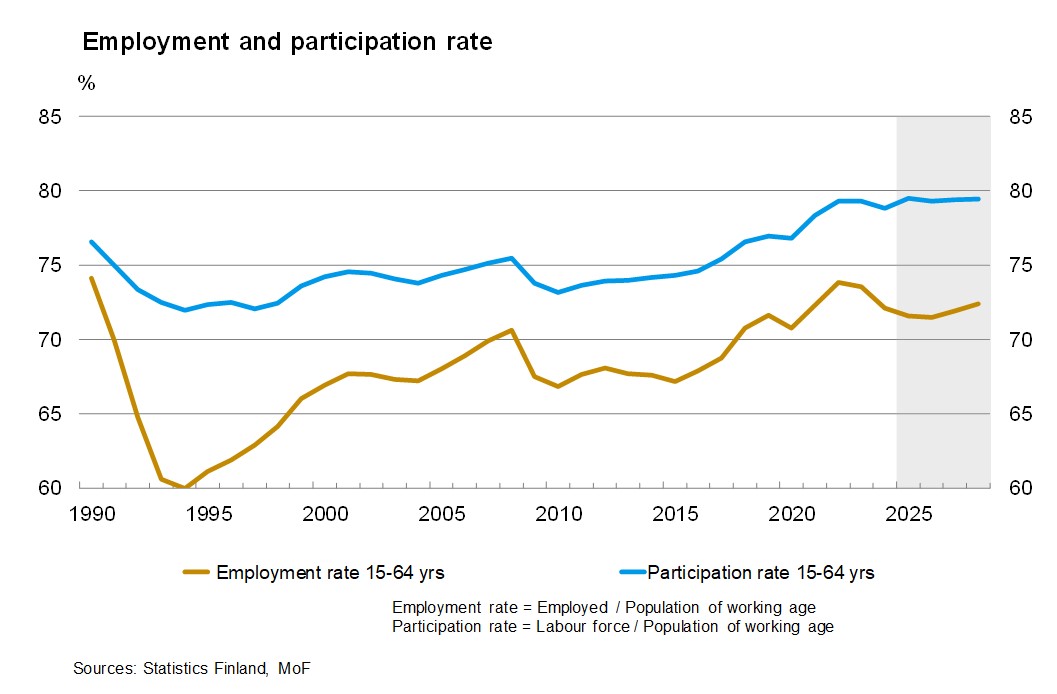
Source: Ministry of Finance. Economic Survey, Winter 2025.
Review of Treasury operations by the State Treasury, January to March 2026
Republic of Finland’s first syndicated issue of the year on 21 January was a new EUR 3 billion benchmark bond maturing on 15 April 2041. The 15-year tenor attracted solid demand with an order book in excess of EUR 25 billion from 160 investors, marking the highest demand ever for Finland’s issuance in this maturity. The bond was priced at 47 bps over the euro mid-swap curve with a re-offer yield of 3.586%. The bond pays an annual coupon of 3.55%.
On 5 February, the Republic of Finland returned to the SEK market for the first time in a decade, issuing a SEK 3.5 bn bond due 15 April 2036 under its EMTN programme. The bond was sold to a small group of investors at a price of 28.5 bps over mid-swaps, resulting in a re-offer yield of 3.23%.
In Q1, the Republic of Finland conducted auctions of serial bonds and euro-denominated Treasury bills. The results of these auctions are summarised below. These include two optional reverse inquiry (ORI) serial bond auctions conducted on 5 February and 26 March.
| SERIAL BOND (RFGB) AND TREASURY BILL (RFTB) AUCTIONS IN Q1/2026 | |||||
| INSTRUMENT | AUCTION DATE | MATURITY | ISSUED AMOUNT (MEUR) | ISSUE YIELD | BID-TO-COVER |
| RFTB | 7 Jan 2026 | 13 Aug 2026 | 875 | 2.030% | 1.74 |
| RFTB | 7 Jan 2026 | 13 Nov 2026 | 1,125 | 2.050% | 1.37 |
| RFGB | 5 Feb 2026 | 15 Sep 2030 | 25 | 2.543% | 13.0 |
| RFGB | 5 Feb 2026 | 15 Apr 2045 | 66 | 3.716% | 7.44 |
| RFTB | 10 Feb 2026 | 13 Aug 2026 | 793 | 1.995% | 2.26 |
| RFTB | 10 Feb 2026 | 13 Nov 2026 | 1,205 | 2.020% | 1.56 |
| RFGB | 17 Feb 2026 | 15 Sep 2035 | 956 | 2.990% | 1.72 |
| RFGB | 17 Feb 2026 | 15 Apr 2041 | 545 | 3.425% | 1.66 |
| RFTB | 10 Mar 2026 | 13 Nov 2026 | 725 | 2.160% | 2.17 |
| RFTB | 10 Mar 2026 | 15 Feb 2027 | 1,260 | 2.250% | 1.17 |
| RFGB | 17 Mar 2026 | 15 Sep 2031 | 867 | 2.840% | 1.73 |
| RFGB | 17 Mar 2026 | 15 Sep 2034 | 600 | 3.104% | 2.00 |
| RFGB | 26 Mar 2026 | 15 Apr 2029 | 385 | 2.860% | 1.96 |
| RFGB | 26 Mar 2026 | 15 Apr 2036 | – | – | – |
In addition to auctions, the tap window for USD- and EUR‑denominated Treasury bill issuance was opened on a number of occasions in Q1. Tap issuance volumes amounted to USD 1,150 million and EUR 3,215 million, respectively.
Near-term outlook for the period of April to June 2026
Following the first supplementary budget proposal for 2026, dated 5 February, the net borrowing requirement is estimated at EUR 13.062 billion, resulting in a gross borrowing amount of EUR 44.204 billion. Approximately EUR 27.3 billion of this amount is expected to be covered with long-term debt, and the rest (16.9 billion) with short-term debt.
In Q2, the State Treasury is planning to issue its second new euro benchmark bond of the year, likely in a 10-year maturity. The long-term funding operations are expected to include three euro benchmark bond tap auctions during the quarter. The State Treasury estimates to complete about 55% of the above annual long-term funding by the end of June.
The next bond auction is expected to take place on 21 April 2026. Further details on the auction and an updated auction calendar are published on: Serial Bond Auctions. The auction calendar for Q2 includes one ORI serial bond auction date.
As in previous years, bonds may be issued under the EMTN programme to complement the funding in euro benchmark bonds during the year, market conditions permitting.
The next auction of euro-denominated Treasury bills will take place on 14 April 2026. The auction will be arranged in the Bloomberg Auction System and is open to the RFTB dealer group. Further information on Treasury bill auctions and a quarterly updated auction calendar will be published on: Treasury bill auctions.
In addition to Treasury bill auctions, a tap issuance window may open during the second quarter of the year. The timing of the Treasury bill issuance is subject to the liquidity position and refinancing needs of the central government. Treasury bills are issued in euros and US dollars.
The next Quarterly Review will be published on 26 June 2026.
Further information: Head of Funding Jussi Tuulisaari, tel. +358 295 50 2616, or Senior Manager Mika Tasa, tel. +358 295 50 2552, firstname.surname@statetreasury.fi at Treasury Front Office.