
Finland has reformed it national fiscal framework. The Parliament adopted the new legislation in December 2025 and it entered into force 1 January 2026, as required by EU legislation. The main features of the framework were agreed already in a Parliamentary Pact on Fiscal Policy, which was signed by nearly all political parliamentary groups. The Parliamentary Pact underlines the broad political commitment to reducing the debt ratio.
In the new framework, fiscal targets are decided by a Parliamentary Working Group on Fiscal Policy (PWGFP). The first PWGFP was nominated in October and in the future, and in line with the new national legislation, the Government will nominate one at the beginning of each government term and for the duration of the government term. The main task of the PWGFP is to determine two fiscal targets: one for an inter-parliamentary period of eight years and one for the 4-year government term.
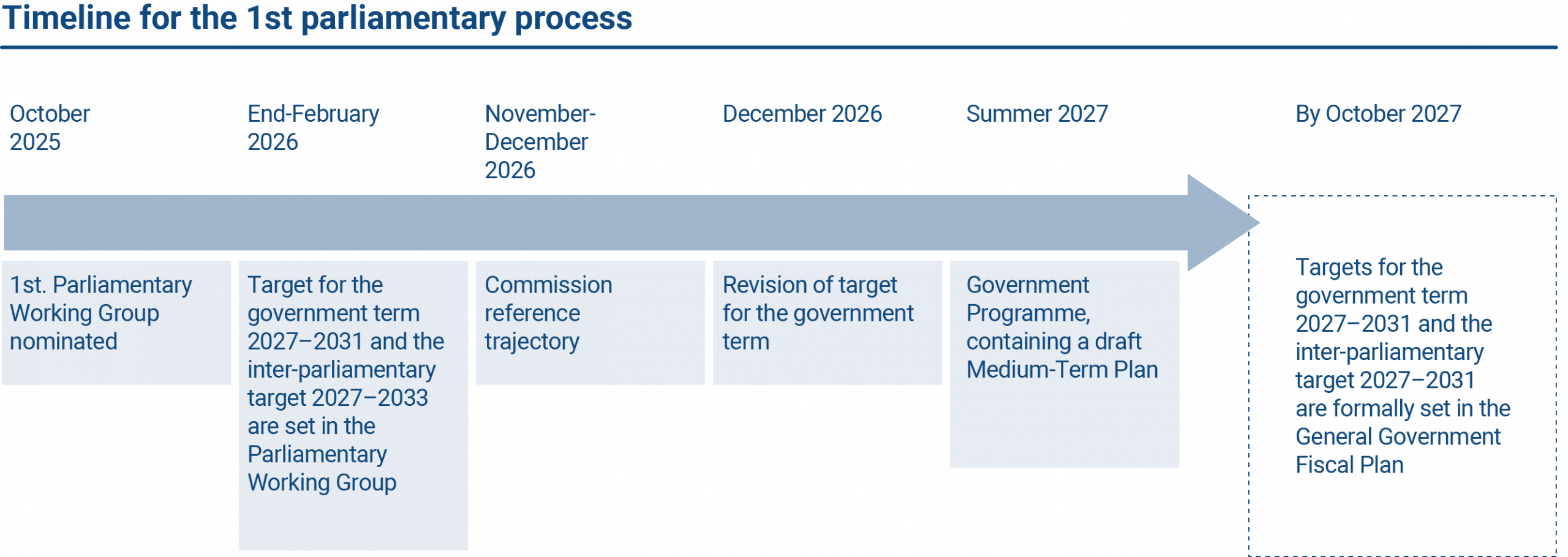
The graph presents the timeline of the first parliamentary process.
For the next government term (2027-2031), both targets are set in February 2026 and the target for the government term will be revised in December 2026, before the parliamentary elections in April 2027. Central to setting the target for the government term in December 2026 is the reference trajectory that is to be received from the EU Commission for the preparation of the Medium-Term Plan to be submitted to the EU early in the government term (a draft to be included in the Government Programme). The target for the government term will always be decided before the elections, while the target for the inter-parliamentary period will in the future be set in the middle of the government term. The PWGFP will also monitor compliance with both targets.
From now on, the fiscal target for the upcoming parliamentary term will be set before the elections.
Both targets are set for the combined balance of central and local governments, i.e. the deficit of the debt-accumulating sectors. Target setting is constrained by the following conditions, the first two of which stem from EU legislation:
– promote compliance with the EU reference values;
– meet at least the requirements of the net expenditure path;
– the target for the government term complies with the target for the inter-parliamentary period;
– the target for the inter-parliamentary period shall be set in such a way that the ratio of general government debt to GDP is expected to decline over the eight-year reference period towards the long-term objective for public finances by an average of at least 0.75 percentage points per year or remain below the long-term objective of a maximum debt ratio of 40% of GDP.
The target for the government term is set for the final year of the term and accompanied by measures to ensure its achievement. The target for the inter-parliamentary period is set as an average over a period of eight years.
The correction mechanism will only be applicable to the target for the government term, which consequently functions as the national fiscal rule. The first part of the correction mechanism will be based on an overall assessment by the Finnish Economic Policy Council, which is the official Independent Fiscal Institution (IFI) after the reform. The IFI regularly prepares and publishes an overall assessment of the achievement of the target for the government term. The IFI overall assessment will take into account among other things the cyclical situation and any escape clauses in force in the EU, thus there is no escape clauses for the surveillance phase in the legislation. The IFI assessment shall consider the achievement of the target for the government term, whether the measures specified in the General Government Fiscal Plan to achieve the target for the government term are sufficient and as an early warning indicator, whether the estimated general government nominal deficit for the current or coming year in relation to GDP is above 2.5 per cent.
The new fiscal framework goes beyond EU requirements.
If, on the basis of its overall assessment, the IFI considers that the target for the government term will not be achieved and that there are no acceptable justifications for deviating from the target, the IFI shall submit to the Government an assessment of the scale and timetable of the necessary corrective measures. The Government is required to make a decision explaining the measures that will be taken to correct the deviation. If no action is taken, the Government is required to publicly explain within two months why no action is being taken (comply or explain).
The other two parts of the correction mechanism are linked to the EU excessive deficit procedure and involve the national parliament.
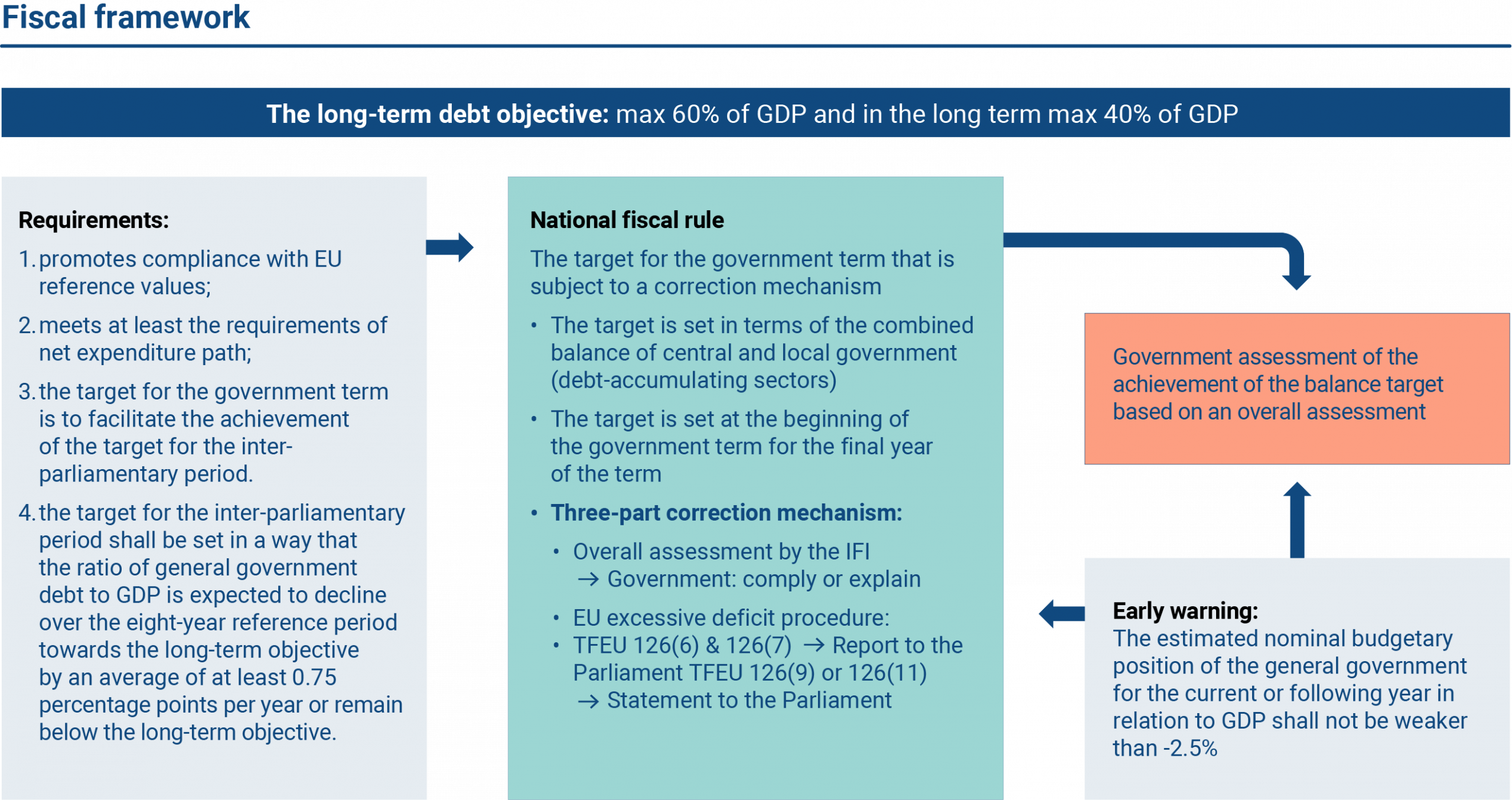
The graph presents the functioning of the fiscal rule and the correction mechanism.