According to a recent follow-up report on sustainable development by the Finnish Government, Finland today is an equal, modern and prosperous welfare state and a pioneer in the advancement of the Sustainable Development Goals. Finland has already achieved 86 per cent of the goals set in the 2030 Agenda for Sustainable Development. This success is built on mutual trust in the society, a well-functioning democracy, equal opportunities for all, equality between genders, free high-quality education, and public healthcare services for all.
Prime Minister Petteri Orpo presented the Voluntary National Review and the conclusions therein to the United Nations High-Level Political Forum (HLPF) in New York in July 2025. The Voluntary National Review (VNR) 2025 constitutes a Finnish self-assessment of the country’s progress towards implementing the goals of the 2030 Agenda for Sustainable Development. This is Finland’s third voluntary review. The previous similar reports were drawn up in 2016 and 2020. The VNR was prepared by the Prime Minister’s Office and the editorial board appointed by it. The expert members of the board included the Ministry for Foreign Affairs and Statistics Finland. Moreover, the report also presents the business sector’s and civil society’s views on sustainable development.
The 2030 Agenda and its Sustainable Development Goals (SDGs), which are binding on all Member States, were adopted in 2016 and are to be achieved by 2030. The deadline is only around five years away. The preparation of a country review for the UN is particularly useful for the Member States, as the process provides an opportunity to uncover potential blind spots in sustainable development. According to the self-assessment included in the VNR, Finland is on the right track in accelerating the achievement of many of the SDGs.
Based on Finland’s experiences, the key to achieving the SDGs is involving different population groups in the transition and ensuring that they also remain involved. Equality is of utmost importance for social cohesion: when the entire society supports sustainability, people feel included and are better prepared for the challenges of the future.
Rapid progress in the green transition
The national review highlights some of the areas in which Finland has achieved particularly good results. For example, Finland has successfully reduced the death rate due to road traffic accidents. In addition, Finland has been a trailblazer in gender equality, taken measures to enable sustainable economic growth by means of, for example, the circular economy, and actively sought international partnerships to promote global sustainable development.
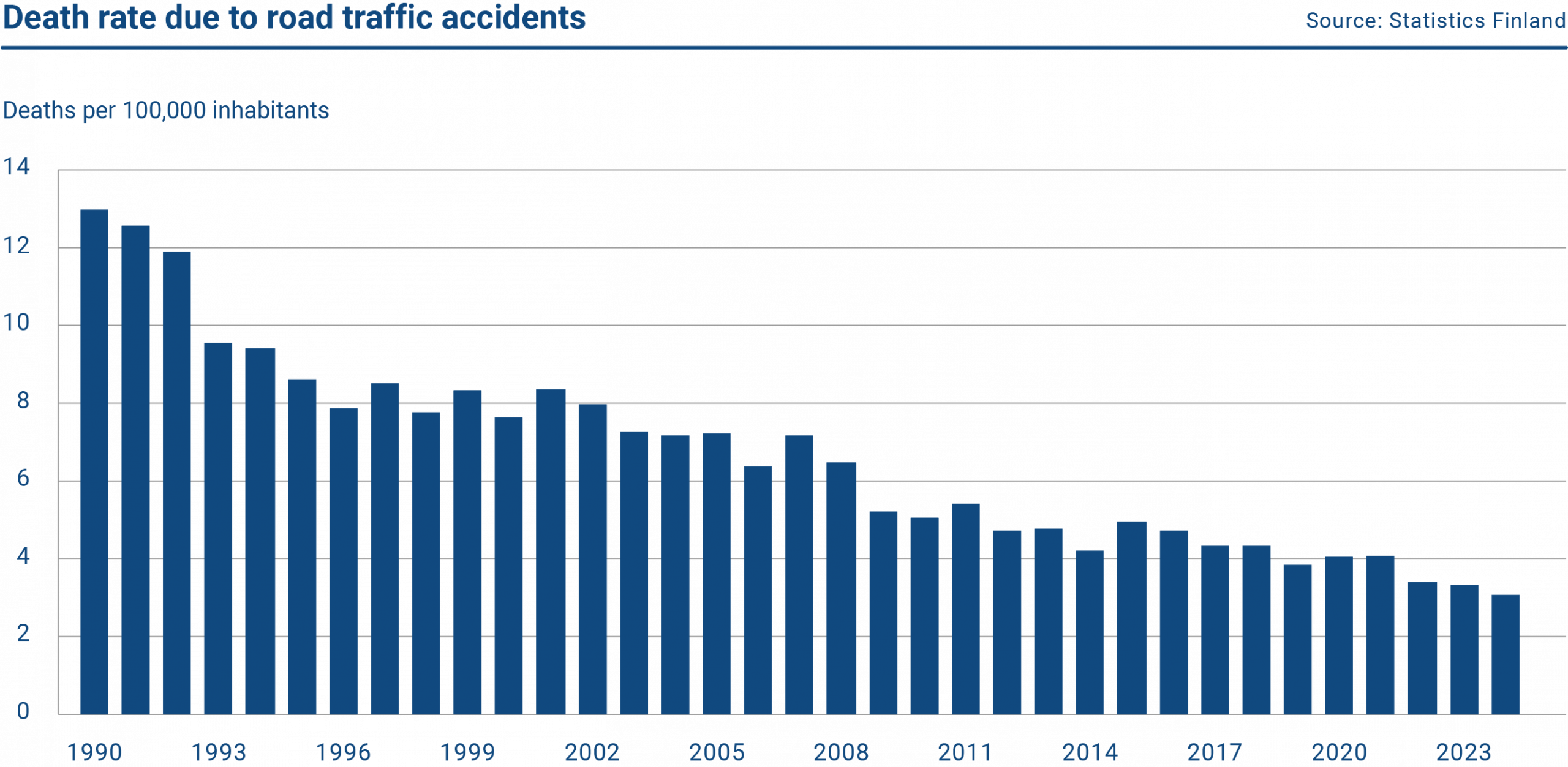
The graph shows the development of death rate due to road traffic injuries from 1990 to 2024. Traffic safety has improved dramatically in Finland. In 1990, the death rate due to road traffic injuries was 12.98, but in 2024 it was just 3.05
Over the past decades, Finland has made significant progress in the green transition and the transition to renewable energy sources. The 2030 Agenda does not contain targets for the SDG indicator on greenhouse gas emissions. However, Finland has made a national commitment to achieving carbon neutrality by 2035. Although the greenhouse gas emissions have decreased significantly and appear to be decreasing also in the future, the goal of reaching carbon neutrality is an ambitious one and requires significant additional measures, especially with regard to transport.
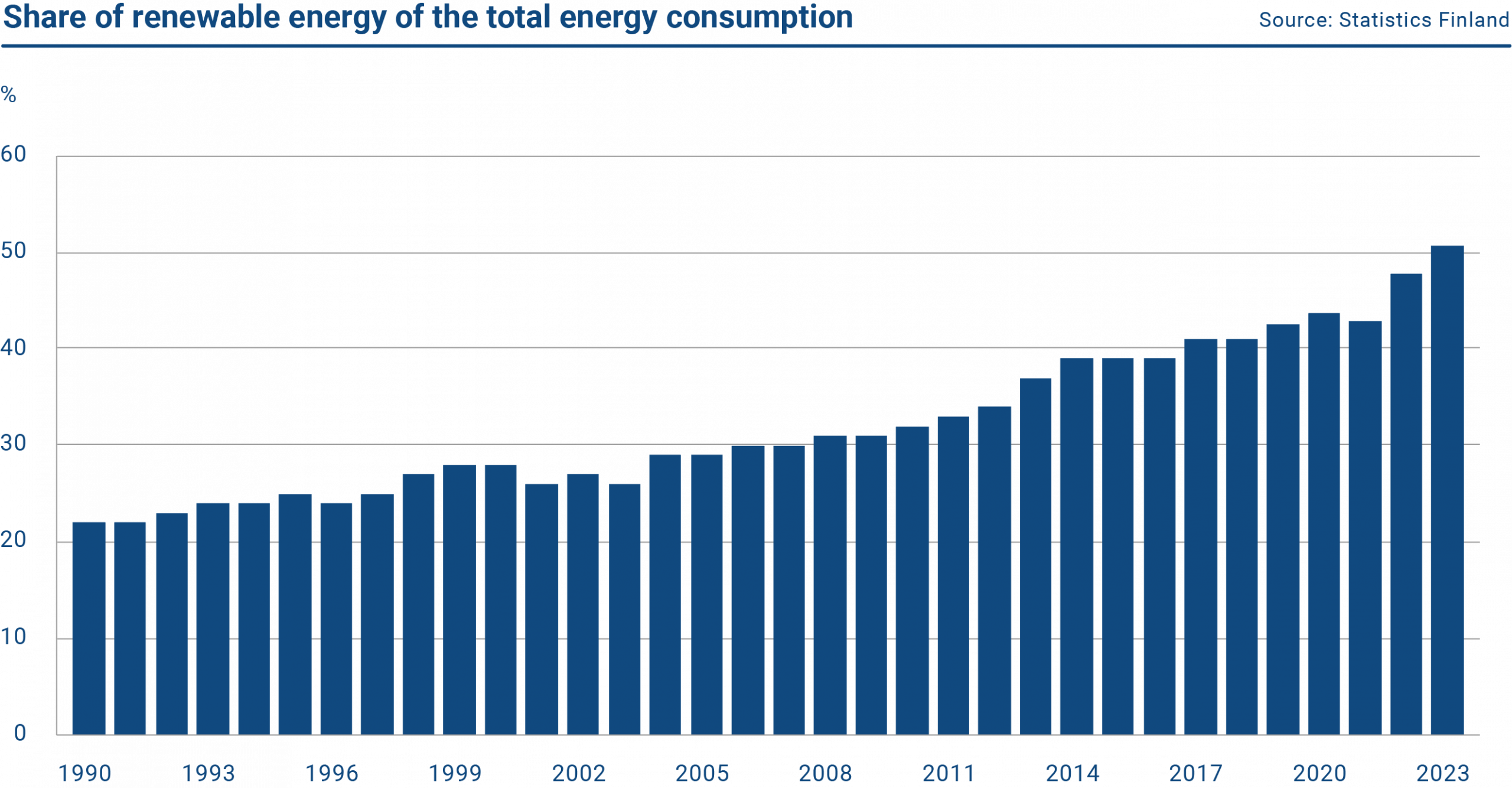
The graph shows the renewable energy share in the total final energy consumption. In Finland, the share of renewable energy in the total final energy consumption has constantly grown from 22% in 1990 to 51% in 2023.
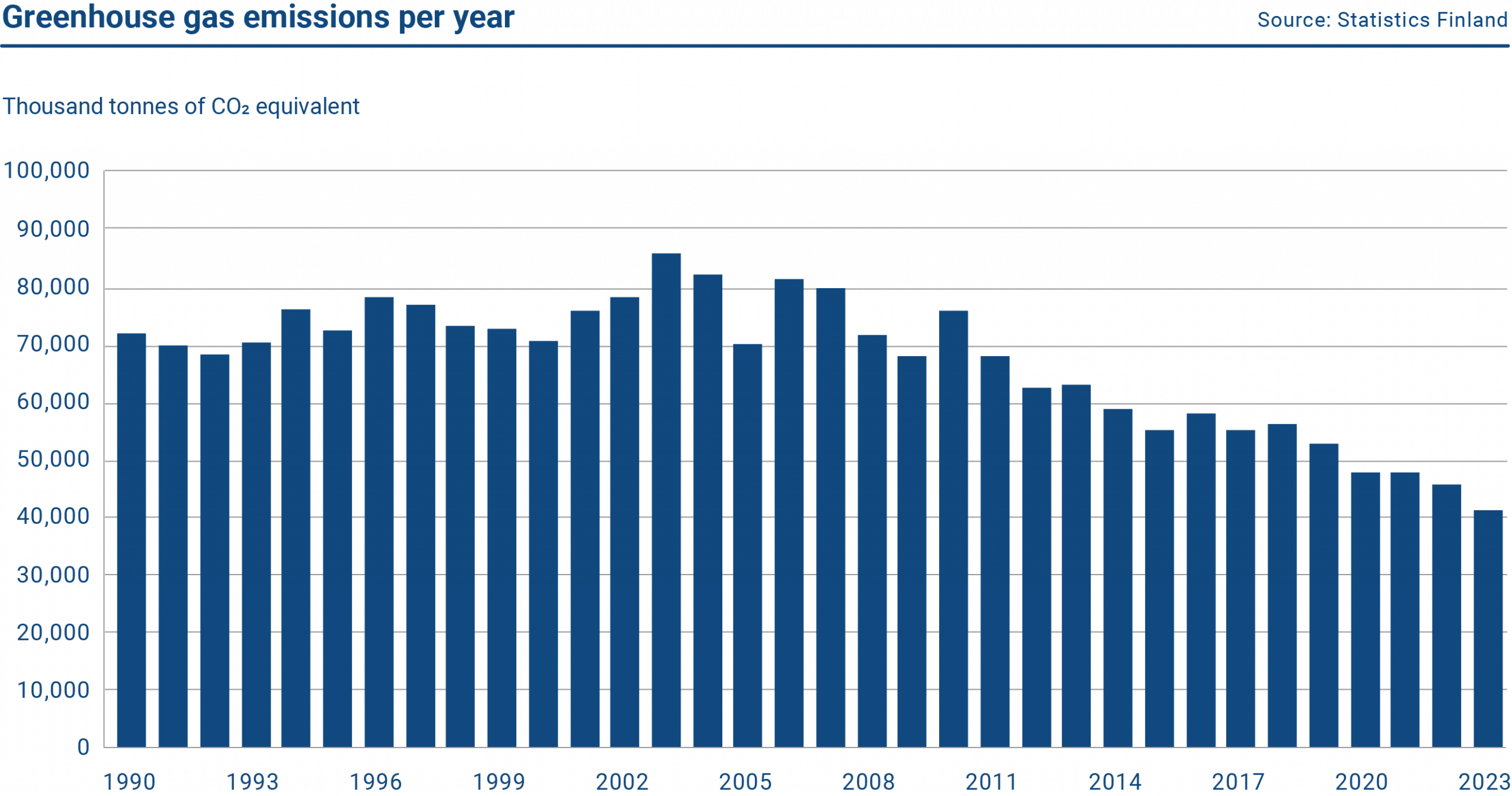
The graph shows the development of Finland’s total greenhouse gas emissions from 1990 to 2023. Finland’s emissions began to decline after 2003. In 2023, total emissions amounted to 41.0 million tonnes of CO₂
Finland’s main challenges are related to ecological sustainability, global responsibility and negative cross-border impacts. Finland is still far from ecological sustainability, especially as regards the forests and their ecosystems which are valued by the country, the high material consumption rates, and the prevention of biodiversity loss. It will be challenging for Finland to achieve the goals set for these areas.
It is estimated that Finland will achieve most of the 2030 Agenda goals by the deadline. However, the advancement of these goals is not entirely without challenges, and Finland’s performance in many of the 169 targets and 248 indicators of the 2030 Agenda varies greatly.
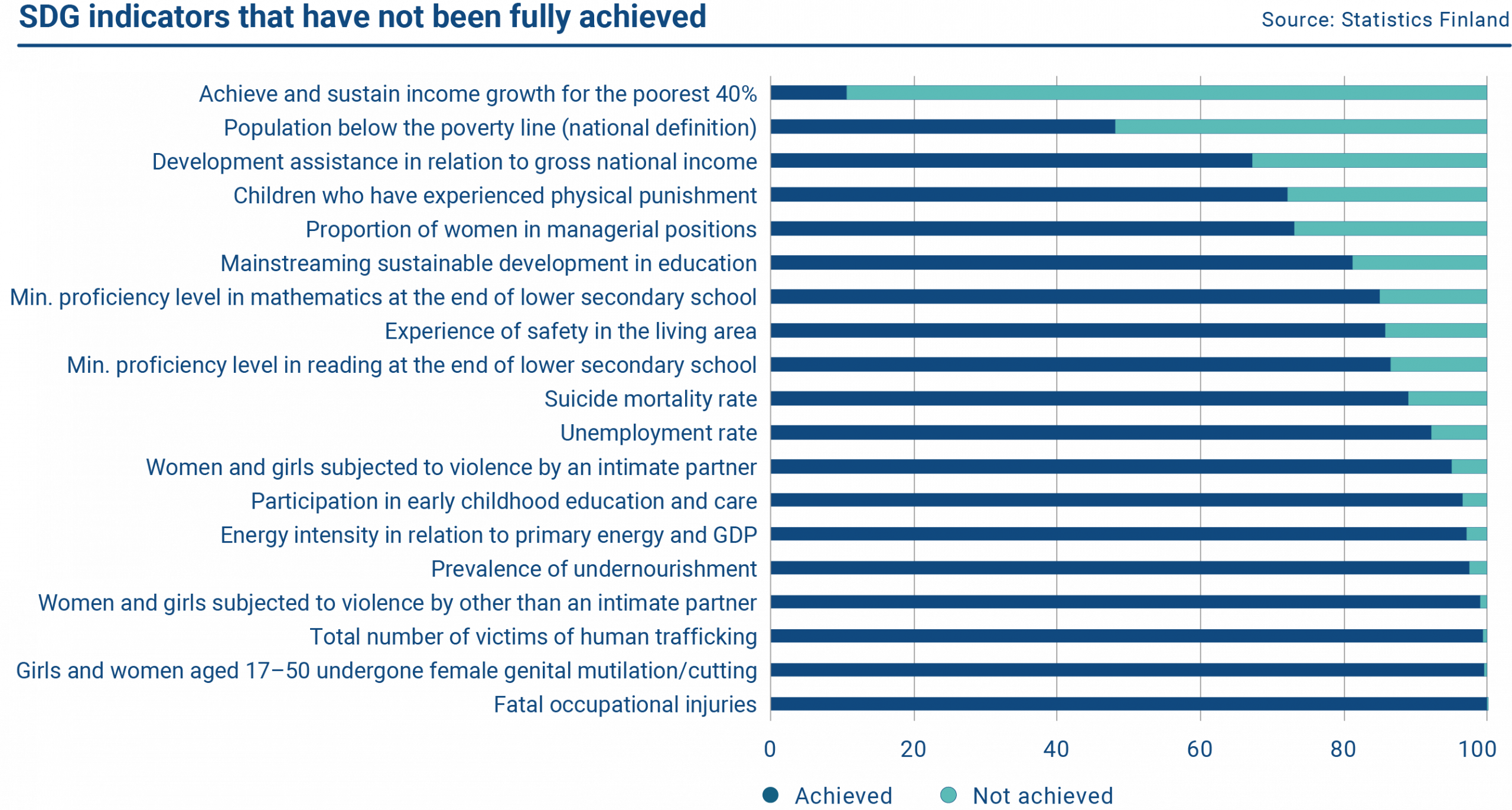
The graph shows the SDG indicators that have not been fully achieved yet in Finland.
Although women hold an extensive proportion of managerial positions in the economy and society, women still hold only a minor share of managerial positions in the private sector. In terms of high-quality education, we are currently drifting away from the positive results already achieved, which means that further measures are required in this area.
The main goals of the 2030 Agenda are to end hunger and halve the number of individuals living in poverty. In Finland, there is no hunger or individuals living below the absolute poverty line. However, according to a national definition, a total of 10.5 per cent of the Finnish population was considered poor in 1990, and 10.9 per cent in 2020. In addition, development assistance in relation to gross national income remains below the 0.7 per cent target.
Achieving the goals requires work
Internationally, Finland is traditionally considered a pioneer in sustainable development, along with the other Nordic countries. For example, the Sustainable Development Solutions Network (SDSN) has ranked Finland as number one in achieving the Sustainable Development Goals for five consecutive years.
As a downside to the international success, Finnish decision-makers have become somewhat complacent in thinking that the SDGS have already been achieved and, therefore, failed to pay enough attention to the new challenges posed by the 2030 Agenda goals. The steering system has been deemed ill-suited for the management of an extensive cross-administrative phenomenon, such as sustainable development.
The vision set in Finland’s sustainable development strategy for 2022–2030 is to achieve a prosperous and globally responsible Finland that protects the carrying capacity of nature. This requires a society-wide approach, as well as continuous monitoring, foresight and flexible decision-making.
Sources:
Progress towards shared wellbeing of people and planet. Voluntary National Review 2025 FINLAND, Report on the Implementation of the 2030 Agenda for Sustainable Development. Publications of the Finnish Government 2025:7.
Sustainable Development Goals Indicators for Finland: Statistical Annex of the Finnish Voluntary National Report 2025 on the Implementation of Agenda 2030. Statistics Finland 2025.